The Waterfall method is often seen as outdated, having been replaced by more flexible hybrid approaches. In reality, Waterfall project management remains the standard today in many complex environments where predictability, traceability, and control take precedence over continuous adaptation.
Among all project management methods, the Waterfall method is ideally suited to fixed requirements, strict regulatory frameworks, locked-in budgets, and projects with high technical dependencies.
The problem is not the method but how it is applied. When misused, it becomes rigid and ineffective. When properly executed, it remains a powerful tool for ensuring successful project management.
Before detailing how to succeed with a Waterfall project, it is essential to understand the contexts in which this approach is not only relevant but often better than modern alternatives.
What is the Waterfall Method?
Project management in the industrial sector, which is characterized by large-scale challenges, is at the core of every project planner. While certain steps and methodologies apply to all projects, there may be specific nuances. You can find our comprehensive guide to project management in one of our previous articles.
The Waterfall Method, is based on a simple principle: each stage of a project must be completed before moving on to the next. It does not involve continuous iteration or adjustment, but rather follows a linear progression planned from the beginning.
We start by precisely defining the requirement, then we design the solution, develop it, test it, and finally deploy it. Each stage has a clear objective, defined deliverables, and a validation point before moving forward.
The key stages of a Waterfall project are generally as follows:
- Requirements Analysis: Precisely define the project’s objectives, constraints, and expectations.
- Planification: Develop a plan detailing the architecture, features, and technical specifications.
- Development: Build the product or solution according to what has been defined.
- Testing: Verify that everything works correctly and that the initial requirements are met.
- Deployment: Make the final product available to the general public.
Unlike hybrid approaches, backwards steps are possible but expensive, which encourages investing more time in the planning phase.
How to properly set up the step-by-step Waterfall Method?
The Waterfall method isn’t just a seamless sequence of the different steps listed above. We’ll explore how to effectively implement this method in your project and avoid mistakes.
Laying a solid foundation for your project
The requirements analysis phase is the foundation of your project. There should be no room for uncertainty before the project is officially launched. It is important here to draft comprehensive functional specifications and have them validated by the various stakeholders.
To avoid any risk you can implement a strict change request process. If the client wishes to modify anything along the way, this must trigger an official amendment with a readjustment of resources and deadlines.
Effectively plan your project
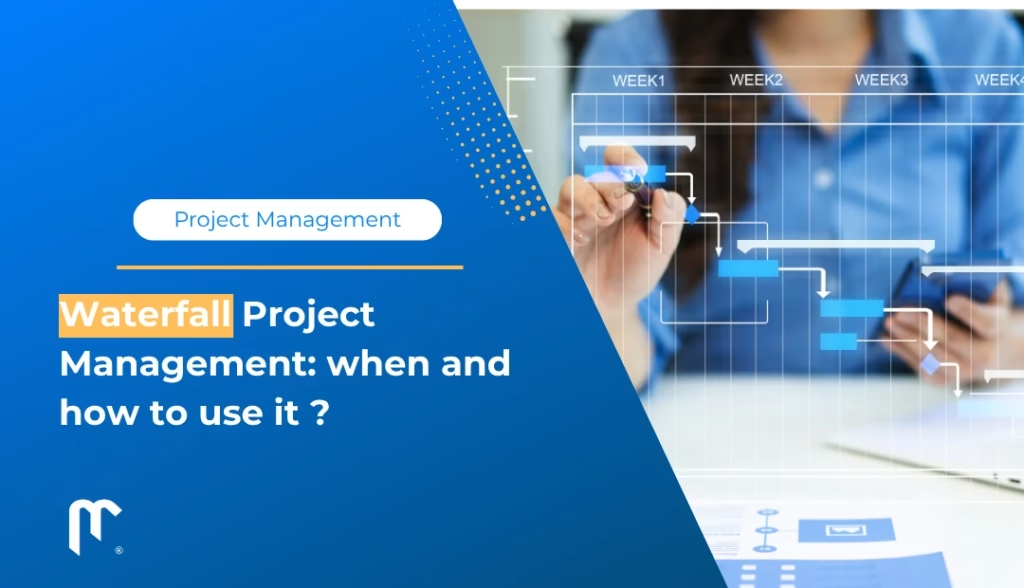
Project planning shouldn’t be limited to creating a Gantt chart or maintaining an extremely detailed, line-by-line Excel spreadsheet. The PMO’s true mission is to identify what is known as the Critical Path. This represents the sequence of essential tasks such that, if any one of them falls behind schedule, it pushes back the project’s final delivery date.
It is therefore important to identify the sequence of tasks that cannot be shortened, as they determine the total duration of the project at this stage of the Waterfall methodology. Next, build in “buffers” around these tasks. This step will allow you to focus your project monitoring on these specific tasks to avoid any problems.
Avoid falling into the “tunnel effect” of the Waterfall method
The major risk of the Waterfall method lies in the “tunnel effect”: that critical gap between the end of the planning phase and the delivery of the finished product. Without continuous communication between the PMO and the client, a gap can develop between the initial specifications and the reality of production.
The success of the development phase depends on establishing systematic transparency regarding technical progress. You must therefore define checkpoints and schedule regular steering committee meetings. These milestones serve not only to validate the schedule but also to confirm that the produced components comply with the specifications.
Traps to avoid
The rigidity of the Waterfall model creates structural risks that the PMO must anticipate. Blindly applying the method always leads to changes in project management. What are the weaknesses of the Waterfall method, and what steps can be taken to avoid them?
Delaying testing
In a classic Waterfall sequence, the testing phase is often treated as the project’s adjustment variable. Postponing all testing until the end of the project lifecycle exponentially increases the risk of late discoveries of critical defects or performance issues.
It is imperative to plan testing from the design phase onward. This is one of the key contributions of the V-Model, which any modern Waterfall method should incorporate. Use cases and tests must be documented in parallel with the functional specifications.
The Structural Depreciation of the Initial Requirement
The market, the regulatory environment, or corporate strategy often evolve faster than a project’s lifecycle. Delivering a product that perfectly aligns with specifications drafted 18 months earlier—but which is now ill-suited to the client’s operational reality—represents one of the systemic failures of the waterfall model.
Implementing strategic review windows tied to intermediate validation milestones becomes essential. The steering committee must maintain active oversight and have the authority to radically reorient a waterfall project if the projected return on investment (ROI) collapses even before delivery.
Resource inefficiency
The strictly sequential nature of the Waterfall model inherently leads to significant downtime and inefficient resource allocation.
Development teams wait for the final, formal validation of requirements analyses before initiating the production phase; conversely, operations teams and testers are left waiting throughout the entire development process.
It is therefore beneficial to optimize resource allocation through dynamic resource leveling and controlled overlap of phases.
The Waterfall model is the obvious strategic choice in environments where mistakes are not allowed or are too costly. It is essential for projects subject to strict regulatory constraints (defense, healthcare, finance), physical engineering projects (construction, manufacturing), or any project whose budget and scope are strictly fixed from day one. The success of a Waterfall project does not depend on staring at a static Gantt chart, but on proactive governance.
However, we must remain realistic: if your market is volatile, the target technology is uncertain, or your client is likely to change their vision along the way, the waterfall project management method will derail your project. It is precisely to address this uncertainty that project management has evolved toward more hybrid methods.