Meeting project deadlines remains one of the primary challenges for planning teams. Between overinflated safety margins, inefficient multitasking, and poorly anticipated dependencies, many schedules quickly become unrealistic. This results in accumulated delays, a loss of visibility, and increased pressure on teams. While traditional approaches provide a structured framework, they often show their limits when resource constraints become critical.
This is precisely where Critical Chain Project Management (CCPM) stands out. It proposes a different approach: optimizing the schedule not just based on tasks, but by fully integrating resources and contingencies. This project management method is particularly effective in complex environments, notably in construction, industry, or engineering.
Is the Critical Chain method suitable for all types of projects? How does it position itself against other project management methodologies?
In this article, we propose a detailed look at how the Critical Chain works, its advantages, its limitations, and concrete cases where it provides real value.
For a global overview and to identify the approach best suited to your context, explore our complete guide: Project Management: techniques, phases, and tools
What is Critical Chain Project Management (CCPM)?
Critical Chain Project Management (CCPM) is a scheduling approach that aims to reduce project lead times and improve deadline reliability by integrating an often underestimated element: resource constraints. Unlike traditional methods, which focus primarily on the sequencing of tasks, the Critical Chain offers a more realistic interpretation of the schedule by accounting for how teams actually work.
Critical Chain vs. Critical Path: What is the Difference?
The Critical Path Method (CPM) represents the longest sequence of dependent tasks without considering resource availability. It identifies the tasks that directly impact the project’s duration.
The Critical Chain method goes further. It integrates both task dependencies and resource constraints. In a practical scenario, a task may become critical not because of its logical position, but because a key resource is already mobilized elsewhere.
Thus, the Critical Chain is often different from the initial Critical Path and, more importantly, closer to the reality.
Key Steps of the CCPM Method
Implementing the Critical Chain relies on four main stages.
Identifying the Critical Chain
Every project planning depends on the critical path; therefore, the first step is to list the various tasks and their dependencies. Next, resource constraints are integrated task by task to reveal the true Critical Chain of the project. For example, if the same resource (a subcontractor or a specific machine) is required for two parallel tasks, the method creates a dependency between them.
Eliminating Individual Safety Margins
In a traditional schedule, each contributor adds a “safety margin” to their forecast to ensure they meet their commitment. Consequently, the global schedule is bigger than needed. CCPM removes these individual margins by cutting initial estimates in half. We move from a “comfortable” estimate (90% chance of success) to an “aggressive” estimate (50% chance).
The objective is to avoid Parkinson’s Law (work expands to fill the time available) and Student Syndrome (waiting until the last moment to start).
Centralizing Safety Buffers
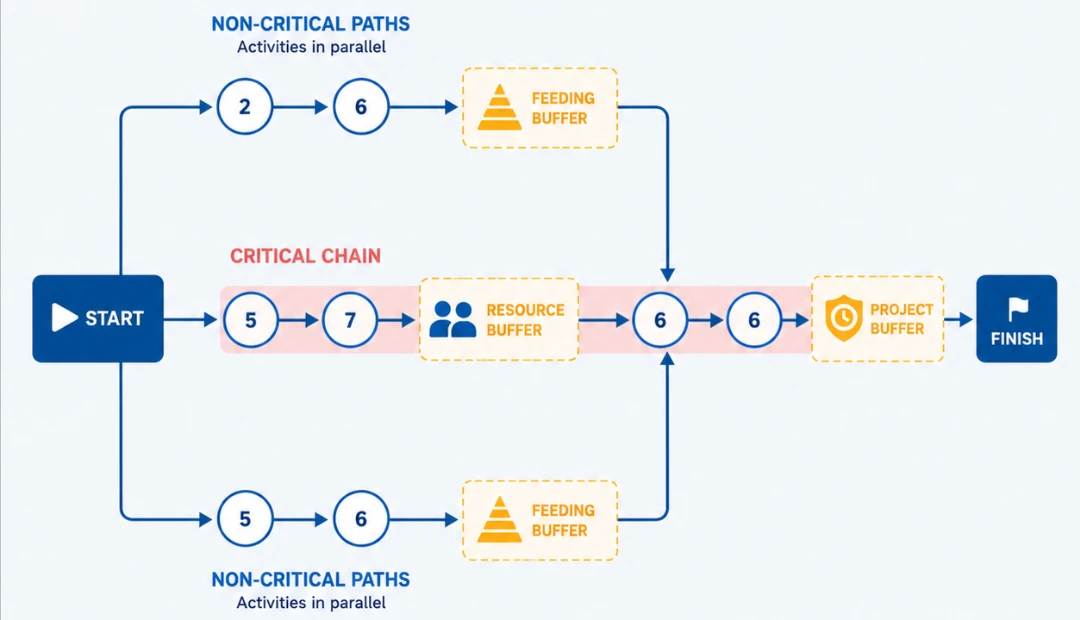
Since safety margins have been removed from individual tasks, they are aggregated into “buffers” and placed strategically to protect the project where necessary. There are three types of buffers:
- Project Buffer: A global time reserve placed at the very end of the schedule. It absorbs contingencies along the critical chain.
- Feeding Buffers: Placed at the intersection where non-critical task paths join the critical chain. They prevent delays in secondary tasks from stalling the main chain.
- Resource Buffers: These ensure that specific resources are set aside or ready in case the critical chain requires more capacity than anticipated.
Buffer-Based Project Management
The Project Manager no longer monitors strict deadlines for each individual task but rather the “health” of the global buffer. To do this, they compare the percentage of project completion against the percentage of buffer consumption. This generates a dashboard known as a Fever Chart, divided into color-coded zones (green, orange, red).
When Should You Use the Critical Chain Method?
The Critical Chain method is most valuable in environments with high deadline pressure and limited resources. It is particularly suited for complex projects involving multiple parallel teams sharing key competencies. It is frequently found in sectors such as engineering, construction, and heavy industry.
Key Benefits and Use Cases
Conflict Resolution: In these sectors, dependencies are numerous and resource conflicts frequent; the Critical Chain restores coherence to the schedule.
Prioritization: It helps prioritize truly critical tasks and avoids the saturation effects of multitasking.
Multi-Project Environments: When a single team works on several projects simultaneously, delays often stem from resource dispersion rather than task complexity. The Critical Chain helps organize priorities and fluidize global progress.
Advantages and Limitations
CCPM improves deadline reliability, reduces project durations by removing unnecessary margins, and provides better visibility through buffer management. However, it requires rigorous planning and reliable data regarding workloads and resources. Furthermore, it is less suited for highly Agile environments where priorities shift constantly, making it difficult to stabilize a critical chain.
Critical Chain or Other Project Management Methods ?
The Critical Chain differs significantly from more traditional approaches like Waterfall or Hybrid methods.
Critical Chain vs. Waterfall Method
The Waterfall method is sequential; each phase must be completed before the next begins. It is highly linear and predictable but lacks flexibility. Conversely, CCPM integrates resource constraints from the outset and optimizes the global flow. While Waterfall secures each stage individually, the Critical Chain centralizes security at the project level via buffers.
Related Reading: Waterfall Project Management: When and How to Use It?
Critical Chain vs. Hybrid Method
The Hybrid method combines predictive and agile approaches. It allows for management styles to adapt based on the project phase or level of uncertainty. The main difference lies in adaptability: Hybrid is more flexible for evolving environments, whereas Critical Chain is more rigid but often more effective where resource and deadline constraints must be strictly mastered.
Related Reading: Hybrid Project Management: How to balance traditional and agile?
Which Software is Best for Identifying the Critical Chain?
Implementing CCPM quickly becomes complex without dedicated planning software. To correctly integrate dependencies and resource constraints while simulating various scenarios, specialized tools are essential. Solutions like Primavera P6 allow teams to go far beyond a simple Gantt chart, facilitating the identification of resource conflicts and the tracking of deviations.
The Critical Chain is not just “another method” in your project management; it is a diagnostic tool. It highlights a problem many organizations underestimate: the failure often lies not in the schedules themselves, but in how resources are utilized and prioritized.
Adopting this approach requires a shift in logic, moving away from a “perfect paper schedule” toward one that survives the test of time. This demands rigour and, above all, execution discipline. In the right context, the gains are immediate: less multitasking, more focus, and finally, mastered deadlines. This is often the difference between a project that is endured and a project that is truly driven.