On large-scale industrial projects, poorly anticipated risks never remain internal issues. They disrupt the entire planning, trigger contractual disputes, lead to delays, and may even result in liability claims.
Project risk management is therefore not a mere methodological exercise. It is the key lever that determines whether you control your project or whether it controls you.
Risk registers, probabilistic analysis, response planning, and continuous monitoring: this guide covers the full process, from early-stage definition through advanced execution phases. The objective is clear: anticipate risks and secure complex projects where margins are tight and contractual exposure is real.
What is Project Risk Management?
Project risk management is a structured process of identifying, analyzing, and addressing uncertainties that may impact project outcomes. It goes far beyond listing potential issues. It requires a continuous approach embedded throughout the project lifecycle, from initiation to close-out.
A risk differs from an issue by its uncertain nature: it has not yet occurred. Once it materializes, it becomes an issue to be managed, no longer a risk to be prevented. This distinction is critical, particularly in complex contractual environments where the boundary between anticipated risk and failure of control may trigger liability for the contractor or project owner.
It is also important to note that risks can be positive. In such cases, they are referred to as opportunities.
Why Do You Need a Risk Management Strategy?
Managing risks reactively, without a defined framework, inevitably creates blind spots. A formalized strategy serves three essential purposes.
Anticipate instead of react
On major projects, schedule slippages and cost overruns often originate from risks that were identifiable during the planning phase. The absence of a strategy does not eliminate these risks. It simply keeps them invisible until they become unmanageable.
Protect contractual commitments
Projects operate within contractual frameworks defining obligations of means or results. Each unmanaged risk becomes a potential source of non-compliance: missed milestones, cost overruns leading to liquidated damages, or disputes over responsibility. Risk management is your first line of defense.
Enable informed decision-making
When facing a risk, project teams must quickly decide whether to absorb, transfer, mitigate, or accept it. Without an up-to-date risk register and prior prioritization, decisions are made under pressure and with insufficient data. A structured strategy turns reactivity into controlled decision-making.
Regulatory Frameworks and Standards
Project risk management is governed by several key frameworks that directly impact stakeholder accountability.
ISO 31000 – The International Standard
Defines principles, framework, and processes for risk management across all industries. It does not impose a single methodology but requires a structured, documented, and continuously reviewed approach. Compliance is increasingly expected in international tenders.
FIDIC Contracts
FIDIC standard forms embed risk management directly into contractual mechanisms. Late or improperly issued risk notifications may invalidate legitimate entitlement to compensation. Contractual form often prevails over substance.
Public Procurement
Public contracts require formal risk control, especially in design-build or PPP projects. Quality Assurance Plans (QAP) and Project Management Plans (PMP) systematically include risk management components.
Understanding these frameworks is not enough. They must be translated into operational practices tailored to the project context.
Four Key Types of Project Risks
On complex projects, the most costly risks are not always the most visible. Four major categories must be addressed.
Technical Risks
Often identified early but poorly assessed, these relate to feasibility, performance, and reliability.
Examples include underestimated design complexity, poorly defined interfaces, unavailable technologies, or equipment failures.
A technical risk not addressed early will inevitably escalate during execution. Fixing a design issue during construction can cost up to ten times more than during the engineering phase.
Schedule Risks
Among the most critical yet least formalized risks, they affect contractual milestones and the critical path.
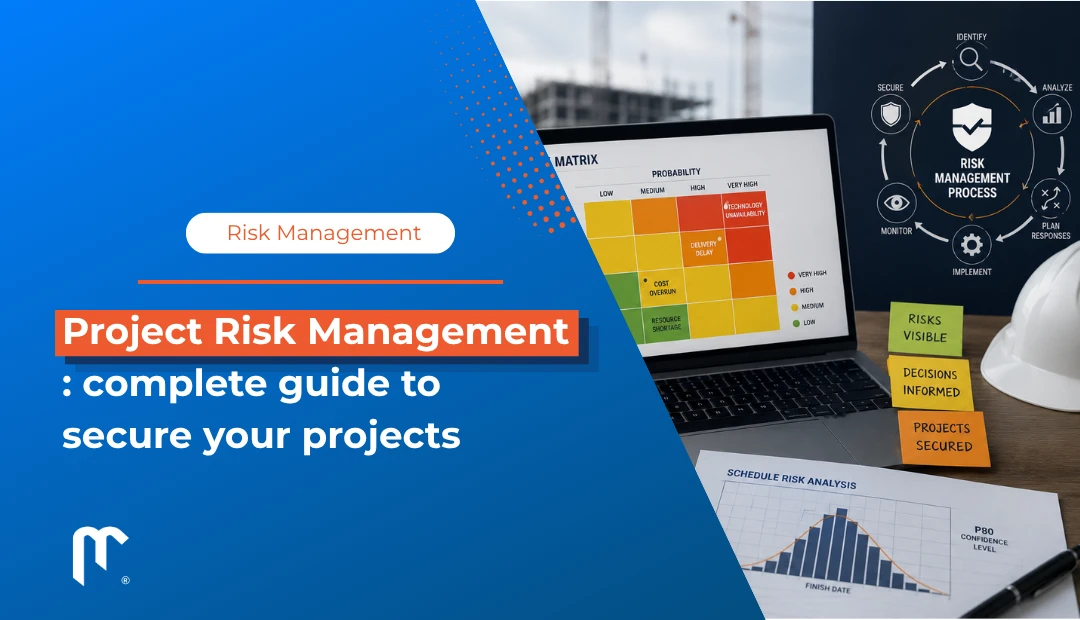
The most effective approach is probabilistic schedule analysis, notably through Monte Carlo simulation. This quantifies uncertainty and provides realistic date ranges with associated confidence levels.
Float is a key indicator. Negative float is not just a scheduling issue, it represents a contractual risk that may impact entitlement to extensions of time.
Financial Risks
These impact the economic performance of the project and are closely linked to technical and schedule risks.
Delays generate additional costs: extended staffing, equipment rental, insurance, etc.
Effective management requires structured budgeting with explicit contingencies, along with sensitivity analyses on major cost drivers.
Contractual and Organizational Risks
Contractual risks stem from ambiguities, scope gaps, unbalanced clauses, or misinterpretation of obligations.
Failure to follow contractual procedures (e.g., notice requirements under FIDIC) can invalidate claims, regardless of their merit.
Organizational risks relate to team structure: turnover, lack of expertise, poor communication, and stakeholder fragmentation.
Mitigation requires:
- Rigorous contract review during tender phase
- Clear responsibility mapping
- Formal change management processes
How to Implement Effective Risk Management (6 Steps)
Risk management is not a one-off exercise — it is iterative and aligned with the project lifecycle.
Step 1: Risk Identification
Use:
- Lessons learned (REX)
- Workshops with stakeholders
- Contract analysis
- Expert consultation
This results in a living risk register, not a static document.
Step 2: Qualitative Analysis
Prioritize risks based on probability and impact using a risk matrix (red/amber/green).
Step 3: Quantitative Analysis
Focus on high-impact risks.
Monte Carlo simulation provides probabilistic distributions of project duration and cost, enabling defensible planning assumptions.
Step 4: Response Planning
Define a strategy for each key risk:
- Avoid
- Transfer
- Mitigate
- Accept
Assign each risk to a clear owner with defined deadlines.
Step 5: Implementation
Risk responses must be integrated into the schedule and cost control systems.
A risk without scheduled actions effectively does not exist operationally.
Step 6: Monitoring and Control
At each project review:
- Have risks evolved?
- Are new risks emerging?
- Are mitigation actions effective?
The risk register must be continuously updated.
Integrating Risk Management into the Project Schedule
A disconnected risk register is merely theoretical. Real value comes from integration with the schedule.
Risk Reviews at Milestones
Each critical milestone should include a formal risk review checkpoint.
Float as a Resilience Indicator
Positive float provides buffer capacity. Zero or negative float indicates immediate contractual exposure.
Synchronizing Schedule and Risk Register
Every schedule update should feed the risk register and vice versa. This transforms risk management into a real decision-making tool.
Key Risk Management Tools
Risk Matrix
Simple and effective for prioritization, but purely qualitative.
Monte Carlo Simulation
Essential for complex projects. Answers:
- What is the confidence level of my milestone?
- What contingency is required?
- Which activities drive uncertainty?
Specialized Software
- Primavera Risk Analysis
- Deltek Acumen Fuse
- Asta Powerproject
These tools integrate risk analysis directly into scheduling environments.
Risk Management Across Project Types
Construction & Infrastructure Projects
High exposure: geotechnical risks, weather, interfaces, regulatory constraints. Irreversibility and contractual pressure make quantitative analysis essential.
Industrial & Energy Projects
Key risk: delayed commissioning impacting production revenue. Critical interfaces between engineering, procurement, and construction (EPC).
Multi-Contractor Environments
Three dominant risks:
- Interface risks
- Cross-claims between contractors
- Governance gaps
Mitigation requires:
- Interface Management Plan
- Joint risk reviews
- Integrated scheduling
Project risk management is not reserved for large organizations. It becomes essential as soon as contractual, financial, or technical stakes exceed what improvisation can absorb.
Two costly mistakes persist:
- Identifying risks only once at project start
- Managing risk registers and schedules in separate silos
Effective risk management is a living process, embedded in every schedule update and driven by teams who understand both contractual and technical implications.
Mesli Consulting supports project teams in structuring and implementing robust risk management frameworks.