
Why Is Project Risk Analysis Essential?
In complex industrial projects, deviations are not anomalies. They are potential outcomes. Schedule delays, cost overruns, technical interfaces and external dependencies all create uncertainty. Without proper structure, these uncertainties can turn into project deviations.
Project risk analysis is more than a methodological requirement. It is a practical project control tool. It helps anticipate deviations, focus efforts where they matter most and support better decisions throughout the project lifecycle.
Anticipating Project Deviations
Projects rarely go off track without warning. Early signals are often present: poorly managed critical dependencies, weak assumptions, poorly defined interfaces or underestimated external constraints.
Project Risk analysis helps identify these vulnerabilities during the planning phases and assess their potential impact on schedule, cost and quality. By structuring these risks, uncertainty can be turned into an anticipated and manageable scenario.
This ability to anticipate is critical when project margins are limited. It helps avoid reactive crisis management, which is often costly and inefficient, and supports a proactive approach integrated into overall project control.
Prioritising Critical Actions
Not all risks are equal. Without prioritisation, project teams can spread their resources across issues with limited impact.
Project risk analysis introduces a prioritisation approach based on risk criticality. It combines the likelihood of occurrence with the potential impact. This makes it easier to identify major risks that require immediate attention and focus efforts where they can have the greatest effect on overall project performance.
This prioritisation is particularly important when time, resources and budget are constrained. It helps align teams around clear objectives and supports the implementation of targeted and effective action plans.
Supporting Better Decision-Making
Effective project control depends on the quality of the decisions being made. A decision based on an incomplete or poorly structured view of risk remains fragile.
Risk analysis provides an objective framework for assessing scenarios, comparing options and making decisions based on potential impacts. It allows uncertainty to be considered as part of the decision-making process rather than simply being dealt with when it materialises.
On complex projects, this approach also strengthens the credibility of project control with stakeholders, including management, clients and partners. It provides tangible and well-supported information, helping secure commitments and improve overall project resilience.
What Are the Key Steps in Project Risk Analysis?
Project risk analysis follows a structured and progressive approach. The objective is not simply to identify uncertainties, but to turn them into manageable factors that can be incorporated into project decisions and operational monitoring.
Identify the Risks
Project risk identification consists of identifying events that could affect project objectives. This step should draw on concrete sources such as previous experiences, schedule analysis, reviews of critical interfaces and discussions with operational teams.
The objective is to highlight areas of project vulnerability, particularly key dependencies, uncertain assumptions and external constraints. An effective approach brings together the perspectives of different stakeholders to identify risks that may remain invisible in a top-down analysis.
This step should remain focused. An excessively long risk list can dilute prioritisation, while a superficial assessment limits the value of the analysis. The aim is to establish a clear and usable basis focused on the risks that could materially affect project progress.
Structure and Formalise the Risks
Once risks have been identified, they need to be organised so they can be effectively managed. Without structure, a risk list is difficult to control and does not support effective prioritisation or operational monitoring. The objective is to provide a clear view of the risks by grouping them into relevant categories, such as technical, schedule, contractual or external risks.
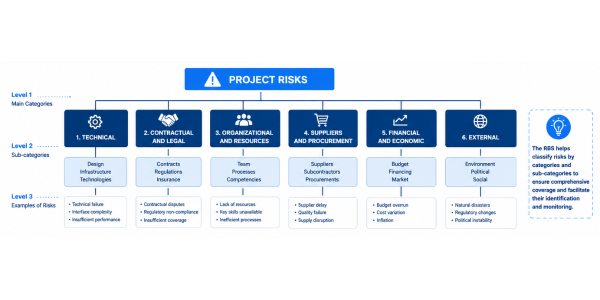
A Risk Breakdown Structure (RBS) organises risks according to a hierarchical structure. This makes it easier to assess the project as a whole and identify the areas with the highest exposure. It also helps ensure comprehensive coverage and reduce blind spots during risk identification.
The next step is to establish a project risk register. This centralises key information for each risk, including its description, causes, potential impacts, owner and initial response actions. It becomes a core project control tool shared by stakeholders and provides the basis for the next stages of project risk analysis.
Analyse and Prioritise the Risks
Project risk analysis assesses each risk against two straightforward and operational criteria: its likelihood of occurrence and its impact on the project, particularly in terms of schedule, cost and performance.
This moves the project from a simple list of risks to a clear hierarchy. In practice, a risk matrix is often used to quickly identify major risks, particularly those combining high likelihood with high impact. These critical risks should receive the greatest attention and be addressed through priority action plans.
Quantify Critical Risks
Quantification measures the potential value of a risk. In practical terms, it means estimating the effect if the risk materialises. How many days could it add to the schedule? What additional cost could it generate? What could be the impact on the critical path?
The simplest and most immediately applicable method is Expected Value. It consists of multiplying the probability of a risk by its potential impact:
Risk = Probability × Impact
For example:
30% probability × €100,000 potential cost impact = €30,000 expected risk exposure.
This provides a quick order of magnitude and allows different risks to be compared objectively. It is also a common basis for professional risk management tools.
For complex projects, scenario analysis and simulations can provide a more detailed assessment. The most widely used approach is Monte Carlo simulation, which tests thousands of possible combinations to estimate the overall impact of risks on the schedule or budget. Instead of producing a single estimate, it provides a confidence level, such as an 80% probability of completing the project by a given date.
Other approaches, such as sensitivity analysis and decision trees, can identify the variables with the greatest influence or compare different options while accounting for risk. These methods are particularly useful when evaluating alternative strategies or determining an appropriate contingency reserve.
Update the Analysis Over Time
A risk evolves throughout the project. It may increase, its impact may decrease or the risk may disappear altogether. New risks can also emerge as the project progresses. Without regular updates, the analysis quickly becomes outdated and loses its value as a project control tool.
Updates should be integrated into established project routines, such as schedule reviews, project meetings and progress reviews. The objective is straightforward: reassess existing risks, monitor the effectiveness of mitigation actions and incorporate new risks identified in the field. The risk register then becomes a dynamic management tool rather than a reporting document.
This approach maintains a realistic view of the project’s risk exposure at every stage. It supports anticipation, reduces blind spots and ensures that decisions remain aligned with the project’s actual conditions.
How to Identify Project Risks?
Effective project risk identification starts with the right sources. Risks can be identified in project documentation, initial assumptions, the schedule and discussions with project teams. Combining these sources provides a more complete view of potential exposure.
Sources of Risk Identification
Project documentation is a first source of analysis. The schedule, contracts, technical specifications, budget and stakeholder register can all reveal potential vulnerabilities. A strong dependency in the schedule or an unsecured assumption can, for example, become a risk.
Project teams and subject-matter experts provide another perspective. Workshops, interviews and lessons learned can reveal risks that are not visible in the documentation. Checklists from similar projects can also complement the analysis.
It is also important to challenge project assumptions and constraints. What happens if a supplier misses its delivery date? What if an approval takes longer than expected? What if a technical interface changes? This type of questioning helps turn a weak assumption into a clearly defined risk.
Structure the Risks Using an RBS
A Risk Breakdown Structure (RBS) groups risks into major categories and then breaks them down into more detailed levels. Typical categories include technical, contractual, organisational, supplier and external risks.
The RBS helps verify that the analysis covers the different sources of risk. It highlights categories with a high concentration of risks and can reveal potential blind spots. It can also be used to support risk workshops and identification checklists.
The structure should be adapted to the project. A generic RBS can provide a starting point, but it should be tailored to the sector, project characteristics and key interfaces. The objective is not to create a complex classification system, but to provide a clear view of the project’s areas of exposure.
The Project Risk Register
The project risk register centralises the information required to monitor each risk. It should include the cause, consequences, likelihood, impact, risk rating and owner. The actions planned to mitigate the risk should also be recorded.
A useful risk register is more than a list of risks. It tracks how risks evolve and whether mitigation actions are effective. Each risk should have a clearly identified risk owner. Its status, likelihood and impact should be reassessed during risk reviews.
The register can also be linked to the project schedule and relevant work packages. For example, a supplier risk can be linked to the activities dependent on that delivery. This makes it possible to assess its direct impact on project progress. The risk register then becomes a genuine project control tool rather than a reporting document.
Qualitative Project Risk Analysis
Qualitative project risk analysis is used to rank risks before carrying out a more detailed assessment. It mainly relies on two criteria: likelihood of occurrence and impact on project objectives.
Likelihood and Impact
Likelihood measures how likely a risk is to occur. It can be assessed using a simple scale, such as 1 to 5. Impact measures the consequences for the project. These may affect schedule, cost, quality or performance.
To ensure consistent scoring, the criteria should be defined before the assessment. For example, an impact rated 5 could correspond to a major delay affecting a critical activity. This prevents different teams from interpreting the rating scales differently.
Risk Criticality Matrix
A risk criticality matrix combines the likelihood and impact of each risk. It provides a quick visual representation of low, moderate and critical risks. Risks falling within the highest levels become the priority for treatment.
The matrix is primarily a decision-support tool. It helps determine which risks require immediate action and which can simply be monitored. It can also be used to select the risks that require quantitative analysis.
Limitations of Qualitative Analysis
Qualitative analysis remains a relative assessment. Two risks can receive the same rating even though their actual consequences are very different. The quality of the result also depends on the available information and the judgement of the people carrying out the assessment.
The matrix is therefore not sufficient for risks with major financial or schedule impacts. In these cases, project risk analysis should be taken further through a quantitative approach. This makes it possible to quantify potential impacts and assess the project’s overall exposure.
Quantitative Project Risk Analysis
Quantitative analysis goes beyond simple risk scoring. It translates risks into measurable data. It can be used to estimate potential cost overruns, delays or the probability of achieving a milestone.
When Should Quantitative Analysis Be Used?
Quantitative analysis is particularly useful for high-impact risks. It can focus on a limited number of critical risks rather than the entire risk register. This approach requires more data and time than qualitative analysis.
It becomes relevant when a decision needs to be quantified. For example: how much schedule contingency should be allowed? What level of budget contingency is required? What is the probability of completing the project by a given date?
Assessment Methods
Expected Monetary Value (EMV) can be used to quantify risk exposure. It consists of multiplying the probability of an event by its financial impact. Sensitivity analysis can then identify the variables that have the greatest influence on the outcome.
For complex projects, Monte Carlo simulation provides a more advanced approach. It runs multiple scenarios based on probability distributions. The result is a range of possible outcomes and a confidence level for the project’s cost or duration.
Limitations of Quantitative Analysis
A quantified result is not necessarily a reliable result. The quality of the model depends on the quality of the input data. An inaccurate probability or unrealistic impact estimate can distort the entire analysis.
Complexity can also become counterproductive. A highly detailed simulation adds little value when the input data is too uncertain. Project risk analysis should therefore remain proportionate to the project risks, the decision at stake and the maturity of the available data.
Interdependencies and Systemic Risks
Project risks are not always independent. A single event can trigger several others. Project risk analysis must therefore also consider the relationships between risks.
The Domino Effect of Interdependencies
A supplier delay can postpone a delivery, block an activity and then push a critical path milestone. Each event increases the impact of the previous one. A risk-by-risk assessment can therefore underestimate the cumulative effect.
To identify this effect, the dependencies between risks need to be mapped. An interdependency matrix, for example, can identify risks that trigger or amplify other events. This helps focus attention on the most sensitive points of failure.
Identifying Systemic Risks
A systemic risk goes beyond a single work package or activity. It can affect several parts of the project at the same time. A critical dependency on a supplier, a shared technical interface or a common resource can create this type of exposure.
The analysis should therefore look for common causes and cascading effects. Risks linked to the same underlying cause should be grouped together. This makes it possible to address the source of the problem rather than treating each consequence separately. Risk network methods can also be used to represent these interactions.
Tools and Methods for Modelling Interdependencies
Several methods can be used to represent these relationships. An interdependency matrix is suitable for an initial assessment. A Design Structure Matrix (DSM) can map relationships between activities, components or risks. Risk networks go further by modelling how risks can propagate.
For complex projects, these models can be combined with Monte Carlo simulation. This makes it possible to assess how multiple uncertainties can influence overall project cost or duration. The model must, however, reflect the actual dependencies within the project. Otherwise, the simulation can create a false sense of precision.
Project risk analysis follows a five-step approach:
- Identify the risks
- Structure and formalise them
- Analyse and prioritise them
- Quantify critical risks
- Update the analysis over time
The main methods are complementary:
- RBS and risk register: structure and formalise risks.
- Likelihood-impact matrix: assess and prioritise risks.
- Expected Value and sensitivity analysis: quantify exposure and identify the most critical factors.
- Monte Carlo simulation: assess possible cost and schedule outcomes.
- Interdependency analysis: identify cascading effects and systemic risks.
The right project risk analysis method depends on the level of risk, the project objectives and the available data. The objective is not to use more tools. It is to build a sufficiently reliable view of risk to make decisions, take action and adjust project control before deviations become problems.